
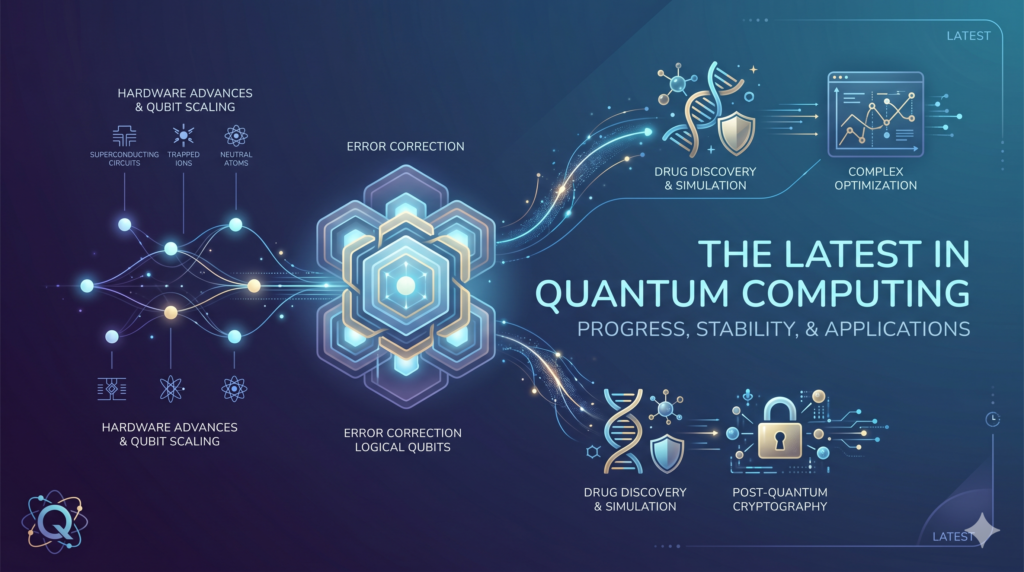
The quantum computing landscape is currently progressing through what is known as the Noisy Intermediate-Scale Quantum (NISQ) era. The focus has shifted from theoretical proofs of concept to engineering physical systems that can withstand environmental noise. Tech giants and research institutions are actively experimenting with a variety of qubit architectures—including superconducting circuits, neutral atoms, trapped ions, and photonic systems—though no single hardware approach has established definitive dominance in the race to build scalable machines.
Recent hardware milestones have centered heavily on error correction and managing decoherence. Because quantum states are incredibly fragile and prone to collapsing into classical states, simply adding more physical qubits to a processor is no longer the primary goal. Throughout 2024, the industry saw significant breakthroughs in creating “logical qubits,” which pool multiple physical qubits together to detect and correct errors in real-time. This shift toward high-threshold, low-overhead fault-tolerant memory is the critical stepping stone required for reliable, sustained quantum computation.
On the algorithmic front, the conversation is maturing from the abstract milestone of “quantum supremacy” to a more practical metric: quantum economic advantage. This framework evaluates whether a quantum system can solve a specific problem faster or cheaper than a comparably priced classical supercomputer. While small to moderate workloads won’t benefit from quantum processing, the technology is demonstrating potential for exponential gains in processing massive datasets for complex optimization, global supply chain routing, and financial risk modeling.
This panel discussion from the University of Chicago explores the current realities of quantum research and its near-term applications in computing and cybersecurity.